Sq. Area : 1,483 Sq km
Population 13,800,000
Avg Rain : 50 cms
Avg Temp: Summer 47°C, Winter 6°C
Airport:
Indira Gandhi International Airport
Bus Stand: Interstate
bus terminus
Train Station: New Delhi station, Old Delhi
station
Tel. Area Code: (91) (011)
Languages:
Hindi
Best Time to Visit Delhi : September thru March
Today Delhi the capital of India, is India's melting pot, drawing and absorbing, over the centuries, settlers and visitors
from
across the globe. Delhi is on the passage to Asia, with roads from across the continent meeting and leading from here to everywhere and anywhere. As the trade and business centre of northern India, its commercial attraction is as significant as its touristic appeal. From forts and temples to hi-tech industries and amusement parks, from pavement hawkers to hypermarkets, from museums and archives to clubs and discotheques, from cycle rickshaws and public buses to BMWs and private taxies, there is little variety that Delhi does not have for the seeking traveller.
The city is littered with crumbling tombs and ruins, most of which are not even on the tourist map. They -- like the elephant trundling alongside a traffic-logged road, where handwritten posters for CUSTOM CONFISCATED GOODS SOLD HERE vie with glossy fashion billboards -- are just part of the strange fabric of Delhi. It doesn't have the vibrancy of Mumbai or the atmosphere of Kolkata, but in one day you can you go from marveling at the sheer grace of the soaring Qutb Minar tower, built in 1199 by the Turkish Slave King Qutb-ud-din Aibak to celebrate his victory over the Hindu Rajputs, to gawking at that 1920s British imperialist masterpiece, the palatial Rashtrapati Bhavan. You can wander through the sculptural Jantar Mantar, a huge, open-air astrological observatory built in 1725 by Jai Singh, creator and ruler of Jaipur, to the still-sacred atmosphere surrounding the tomb of the 14th-century Sufi saint, Sheikh Nizamuddin Aulia, or the 16th-century garden tomb of the Mughal Emperor Humayun, precursor to the Taj. Or, after the chaos of exploring the crowded streets of 17th-century Shahjahanabad, Delhi's oldest living city, you can escape to Rajghat, the park where Gandhi was cremated in 1948, or to the Lodi Gardens, where lawns and golfing greens are studded with the crumbling 15th-century tombs of once powerful dynasties. And still you haven't covered the half of it. But despite its host of attractions, unless you're staying in one of its top hotels (of which the Imperial is almost a destination in its own right), Delhi is not a very relaxing destination, and it is as famous for its pollution (it was rated the 4th most polluted city in the world through the 1990s) as it is for its sights. Unless you're a history buff or here on business, spend as much time as you need to recover from jet lag, choosing to view only a few of its many attractions ( the best of which are listed below ), and then move on, for the rest of India, with its awesome array of experiences and beauty, awaits.
Delhi GeographyGeographically, Delhi is situated on the banks of the River Yamuna in the northern part of the country. It is surrounded by different states on all the four sides. Delhi weather
is an extreme continental type, with winters extremely cold and summers very hot. In winters the temperature drops down to less than 4 degree Celsius and in summers it soars to as high as 48 degrees Celsius. Precautions are necessary both in winters and summers to beat the chilly winds and the heat waves.
Monuments of Delhi- The Red FortAlso known as The Lal Quila (Lal = red, Quila = fort), stands on the banks of Yamuna. It is surrounded by a perimeter wall of about 2.4 Kilometers and is built of Red Sandstone.
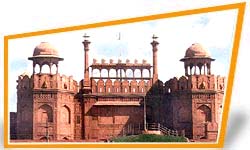
The Mughal king Shah Jahan (who also built the Taj Mahal) transferred his capital from Agra to Delhi and the fort was completed in 1648, nine years after the king shifted to this city. The fort has two main entrances, the Delhi Gate and the Lahori Gate which faces the famed Chandni Chowk market.
- Purana QilaPandavas had built their capital, Indraprastha at the place where the old fort stands today. This fort, now in ruins, was the seat for administration for many emperors. The legendary Prithviraj Chauhan ruled from here till he was defeated by Abdali in the battle of Panipat. A new light & sound show is held by the Department of Delhi Tourism every evening. Timings and Tickets are available from the tourist office.
- Qutab MinarIt was built
by a muslim king, Qutub - ud - din in 1199 AD and a part of which he
could not finish was completed by Itutmish, another Muslim king. It
is situated in the southern part of the capital. The height of the
tower is about 72.5 meter high and there is a mosque at its base. In
front the Qutub Minar there is an iron pillar which is believed that
it was built in 5th century. The uniqueness part of the pillar is
that it has not rusted ever since it was built. Due to some
precaution the Tourists are not allowed to climb the Qutub Minar
i.e. to the tower.
- India GatePrimarily a
memorial to the unknown soldier was designed by Lutyens. The 42
meter high structure is a war memorial in honor of the soldiers who
died during the second world war. The imposing structure from where
stretch massive lush green lawns has an eternal flame (Amar Jawan
Jyoti) to honor the memory of the unknown soldiers. India Gate
prominently located in the vicinity of Rashtrapati Bhavan is a major
crowd puller during the hot summer evenings of Delhi by virtue of
its lush green lawns.
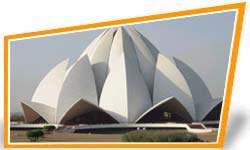
- Lotus TempleCompleted
in 1986, the Bahai temple is set amidst pools and gardens, and
adherents of any faith are free to visit the temple and pray or
meditate silently according to their own religion. The structure is
in lotus shape so it often called the lotus temple. The view of the
temple is very spectacular just before dusk when the temple is flood
lit.
- Rashtrapati BhavanThe house that houses
the President of India and the house that boasts of having welcomed
the most powerful men in history. The Rashtrapati Bhavan was
designed by Edwin Lutyens and built in 1931, to be the central point
of the British power in Delhi. Originally called the Viceroy's
House, the Rashtrapati Bhavan covers an area of 4.5 acres of land.
It has 340 rooms, 37 salons, 74 lobbies and loggias, 18 staircases
and 37 fountains. The most magnificent room in the Rashtrapati
Bhavan is the Durbar Hall, which lies directly beneath the main
dome. All important Indian State and Official ceremonies are held
here. To the west, is the famous and beautifully landscaped Mughal
Gardens, designed after the terraced gardens the Mughals built in
Kashmir. The garden is famous as the 'Butterfly Garden' for the
numerous butterflies that visit the varied flowers. The garden is
open to the public in February.
- Humayun's TombBuilt
by the wife of Humayun, Haji Begum in the mid 16th century, this red
sand stone structure is considered to be the predecessor of Taj
Mahal. The structure is one of the best example of Mughal
Architecture. Humayun's wife is also buried in the red and white
sandstone, black and yellow marble tomb. The entry in the complex is
free on Fridays.
- RajghatThe simple square
platform of black marble on the banks of the river Yamuna marks the
place where Mahatma Gandhi was cremated. His last words 'Hey Ram'
are inscribed on this platform which is surrounded by a serene
garden.
- Parliament HouseA marvelous piece of
architecture where the bicameral legislature of India meets for its
sessions. Lok Sabha, the lower house and Rajya Sabha the upper
house. Close to Rashtrapati Bhavan, is a domed almost circular
structure almost a kilometer in circumference, and was designed by
the famed architect Lutyens. It is the seat of the Indian Parliament
and during the sessions of Parliament there is a flurry of activity
in and around the structure.
- Jamma MasjidOne
of the Architectural gift given by Shah Jahan (who built Taj Mahal),
Jama Masjid is one of the largest mosques not only in Delhi but in
India. Completed in 1658 this Mosque has three gateways, Four angle
towers and two 40 m high minarets. You can enter the mosque but take
precaution to take off your shoes and make sure that you are
properly dressed before entering. One can also go to the top of
minarets. From here you can have a birds eye view of Delhi.
-
Jantar MantarSet within the a garden of stately palms, it was built by Maharaja Jai Singh of Jaipur in 1719.
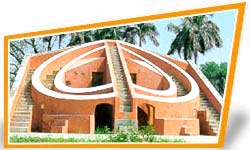
He had been entrusted with the task of revising the calendar and correcting the astronomical tables then in use. He made daily astral observation for seven years before embarking on these stone constructions. He discarded the usual instruments of brass and built these massive ones in masonry which are used to the movements of stars. This observatory, together with the one at Jaipur, are the finest examples anywhere of observatories modeled on the general pattern laid down by Ulugh Baigh of Samarkand in the 14th century. The observatory is conceived with perfect stability and is adjusted to the meridian and latitude of the location.
-
Safdarjung's TombSafdarjung tomb is besides the Safdarjung
airport. This tomb was built by the Nawab of Avadh for his father.
The structure is one of the finest example of architecture of its
time and tells the saga of a dying empire.
Delhi
NightlifeDelhi nightlife is becoming as vibrant as in
Mumbai. With numerous pubs and bars like Decibel and Athena popping
up, it is slowly becoming a way of life in Delhi to hang out in the
night. Like a lot of the other Indian cities, you can almost always
find a good bar or club at a 5-star New Delhi hotel.
Delhi
ShoppingDelhi is a shopper’s delight. There are a lot
of markets in Delhi. Some of the more famous all purpose one’s
are C.P, Lajpat Nagar, Karol Bagh, Kamla Nagar (frequented by many
youngsters), and Janpath (for the cheap, handy stuff).
Best
time to visitTemperatures range from 5 degrees C to 46
degrees C. The best time to visit is October-March. Summers in Delhi
are very hot and it is not recommended to visit it during May, June
or July.
How To Get There-
AirDelhi is a major International Gateway to India. It has
an extensive network of International as well as domestic flights.
All the major airlines in the world fly through Delhi, and it is
easily accessible from anywhere in the world. Domestic air links
cover Delhi from all the major cities in the country.
-
TrainDelhi is an important rail center connected to all
places in India. It is an excellent place for booking too. There are
two main stations in Delhi, Delhi Station and new Delhi station at
Old Delhi and Paharganj respectively. There also the Nizamudin
station in South Delhi. Trains run from all the parts of the country
to Delhi. For nearby places like Chandigarh, Dehradun, Gwalior,
Bhopal, Lucknow and Kanpur, the Shatabdi Express is recommended.
-
BusBuses from all major places in Uttar Pradesh, Punjab,
Haryana, Himachal Pradesh, Madhya Pradesh and Rajasthan are
available for getting to Delhi. During the summer months,
air-conditioned coaches are recommended.