Sq.
Area: 82sq kms Population 1,400,000
Avg Rain: 66 cms
Avg
Temp: Apr thru Jun 22°C to 42°C, Winter 4.2 to 29°C,
MaxTemp in May 45°C.
Airport: Kheira Airport
(Domestic and International)
Bus Stand: Idgah Bus Stand
Train Station: Raja ki Mandi and Agra Cantt
Tel. Area Code: (91) (0562)
Languages: Hindi, Urdu, and English
Best Time to Visit Agra ( Taj mahal, heritage monuments etc. ) : Oct thru Mar
The city of the Taj Mahal and once the capital of the Mughal empire, Agra, has several monuments which display the splendour of Mughal architecture.
It was here that Babar, the founder of the dynasty, had the first formal Persian garden laid out on the banks of the river Yamuna. Akbar, his grandson, raised the towering ramparts of the great Red Fort, within whose walls Jahangir built rose-red palaces, courts and gardens, and which Shahajahan embellished with marble mosques, palaces and pavilions of gem-inlaid white marble. Agra is mentioned in the ancient epic Mahabharata as Agraban, the sister city of the more prominent Mathura. Agra was established in 1475 by Badal Singh and came into its own when Sikander Lodhi of the Lodhi dynasty chose it for his capital because of its proximity to the Yamuna. Babur defeated the Lodhis to capture not only Agra but also to lay the foundation of the Mughal empire. In the mid-16th and earlier 17th centuries, Agra witnessed a frenzied building activity and it was during this time that the symbol of love, the Taj Mahal, was built. The buildings made during this era were purely in the contemporary Mughal style and of very high quality. Besides the monuments, Agra is worth a visit for the masterpieces of craftsmen recreating the glory of the Mughal period and for the Mughlai cuisine, the aroma of which fills the narrow lanes of Agra.
Monuments in Agra
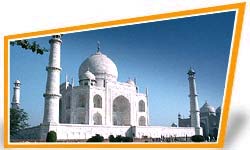
- Taj Mahal The source of the name 'Taj Mahal' is not very clear but scholars believe that it originated from the abbreviation of the empress' name, Mumtaz Mahal and translated to 'Crown Palace'. It took twenty-two years, thirty-two million rupees and hard toil of more than twenty thousand workers to construct Taj Mahal. Completed in 1648, the documents regarding construction of Taj cite the name of Ustad Isa, a very famous architect, well versed in the Islamic architecture, as its chief architect. The documents also list the names of persons employed for this grand work and and the inventory of the construction materials and from where they were brought. From this source, we have learnt that expert craftsmen from Delhi, Kannauj, Lahore, and Multan contributed to the task along with the specialized tasks being handled by the renowned Muslim craftsmen that came here from Baghdad, Shiraz and Bukhar\a. It as the manifestation of one man's unfathomable and unshakable desire for the woman he loved - the woman who proved her loyalty and everlasting friendship to him till her last breath, a woman of great physical and inner beauty and a woman of substance and strength.
- Fatehpur Sikri40 km from Agra, the city of Fatehpur Sikri served as the capital of the Mughal Empire between 1570 and 1586. But as abruptly as it had been built,
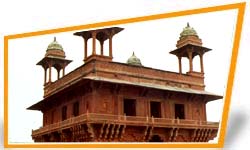
it was abandoned due to the scarcity of water. A popular legend is attached to the city's conception. According to it, Emperor Akbar was without a male heir, and was granted one by the blessings of the Sufi saint Sheikh Salim Chisti. In honor of the saint, Akbar named the prince Salim, and decided to found a new city to celebrate his birth. And thus, the magnificent Fatehpur Sikri, the new capital, came into being. The city was intended to embody the noble ideals, and the humanitarian bent of this dynamic emperor. The finest monuments within this area are the Diwan - i - Am, Diwan - i - Khas, Panch Mahal, Jama Masjid, Panch Mahal, Buland Darwaza and the tomb of Saint Sheikh Salim Chisti.
- Itmad-ud-daulah Sometimes known as 'Baby Taj', this mausoleum is considered as the imminent precursor of the Taj Mahal as far as elaborate carvings and inlay work are concerned. Itmad-ud daulah, stands across the River Yamuna from the Taj Mahal. Belonging to the age of Jahangir, it contains cenotaphs of Mirza Ghiyas and Asmat Begum, parents of the powerful Mughal Empress Nurjahan, queen of Jahangir. Jahangir made him his
prime minister with the title Itmad-ud-daulah (Pillar of the State). The tomb was built in the famed Char Bagh style that Itmad-ud-Daulah had himself laid out six years before his death 1622. The monument is beautifully conceived in the white marble with mosaic and lattice.
Agra ShoppingAgra has its share of malls where you get the usual stuff, but it is the upbeat markets like the Sadar Bazaar and Kinni Bazzar that tempt the locals and tourists alike. You can buy souvenirs and replicas of the Taj Mahal made from real marble.
The city is a major hub of leather goods, so you can get quality leather for reasonable prices. You can get also get high quality carpets and brass decoratives at reasonable rates in Raja Mandi and the Gangotri.
Agra CuisineThe city, being a major tourist market, has lots of multi-cuisine restaurants. Do not forget to try the salty snack Dal
Moth, which is a local delicacy. And after completing your meal, try yummy sweet dishes like the Petha or Gazak.
Agra NightlifeNot much to write home about for Agra nightlife, but there are decent bars in the 5-Star Agra hotels.
Agra ClimateThe city becomes really hot during the summers, so the best time to come is during the winters. Avoid coming during the
rainy season, as the city becomes a bit dirty during that time. With all the three mode of transport, the city is very easily accessible.
How to Reach Agra
- Reaching Agra by Air Agra is connected to Delhi by a daily flight of Indian Airlines (30 minutes) that continues to Khajuraho (35 minutes) and Varanasi (40 minutes}, from where it returns the same day.
Kheria Airport is located 6 km from the city centre. Taxis and auto-rickshaws are available for transfer to the city. Indian Airlines, Hotel Clarks Shiraz pre-recorded information Kheria Airport
- Reaching Agra by RailAgra is best connected to Delhi by superfast luxury and express trains. The same day return services of Shatabdi Express to Bhopal via Agra I hrs.), Gwalior and Jhansi Taj Express (2.5 hrs), Intercity Express (3.5 hrs.) and are the best options that also make short excursion tours to the city possible. A shatabdi-type superfast luxury trains has now also been introduced between Agra and Jaipur.
Being on the major trunk routes of Indian Railways, Agra is also con- nettedto all other parts of the country by express trains.
Agra Fort (for Jaipur) and Agra Cantt Railway Stations are the main entry points of the city. Agra Cantt. Railway Station is about 1.5 km from
downtown Sadar Bazar and about 5 km from the Taj Mahal. Taxis and auto-rikshaws are available at the railway station for transfer to different parts of the city. A pre-paid service for taxis and auto-rikshaws, is operated by the railway police, the booking counter for which is located close to the main exit gate at platform no. 1.
Amongst the services offered are transfers to hotels, etc. and car and auto-rickshaw hire for sightseeing. Full-day sightseeing tour by car with coordinated timings with arrival and departure of Shatabdi Express.
Reaching Agra By RoadBy Road For those driving from Delhi, the best route is by Mathura Road via Faridabad (25 km), Palwal, Hodat, Kosi and Mathura {145 km). There is a dual-carriageway national highway for most of the journey from Delhi to Mathura.
Facilities En route There are rest houses with catering facilities on the highway after every 50 to 75 km. Hodal: The midway point, Hodal, has
a Haryana Tourism facility including a motel last food restaurant and entertainment. Kosi: At Kosi, an ITDC hotel offers accommodation as well as eating and bar facilities. Being an important highway on which traffic operates at all hours, there are adequate number of petrol stations and workshops all along the route.