Aurangabad has a number of attractions and could easily stand on its own were it not overshadowed by the famous EIlora and Ajanta caves nearby.
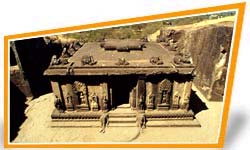
The city is named after Aurangzeb. but earlier in its history it was known as Khadke. Aurangabad is northern Maharashtra's largest city though it is remarkably uncrowded and quiet except for the occasional politicalrally. Today, it is known for some of the finest colleges and university in Maharashtra. And it is the fastest growing industrial town in India. But the charm and glory of its long past has not been lost. And its heritage is rich and varied - the result of the artistic and cultural influences of several dynasties since its first Stone Age inhabitants.
The Aurangabad Caves were built during the 6th and 7th centuries. The walls of the caves have interesting illustrations from the Jataka stories. The Bibi-ka-Maqbara is a tomb built in memory of Aurangzeb's wife Rabia-ud-Daurani Begum. Panchakki is known for its watermill, which is fed by an underground channel from a source located 6 km away in the mountains. The Himroo Factory manufactures traditional himroo fabrics besides Paithani saris, handloom shawls and other textiles material. Killa Arrack is a citadel built by Aurangzeb in 1692. The Jama Masjid, also built by Aurangzeb, is a low building with minarets and a broad band carved with Koranic inscriptions. The Kali Masjid, built in 1600, is another important monument of Aurangabad. The Shah Ganj Mosque built in 1720 is located in the market square of the old city. The Chauk Masjid is a five-dome mosque built by Shayista Khan, uncle of Aurangzeb in 1665. The Lal Masjid is located in the old city area of Aurangabad.
Place To See In Aurangabad
- The Ajanta Caves About 107 kms from the city of Aurangabad, the rock cut caves of Ajanta nestle in a panoramic gorge, in the form of a gigantic horseshoe. Among the finest examples of some of the earliest Buddhist architecture, cave paintings and sculptures, these caves comprise Chaitya Halls, or shrines dedicated to Lord Buddha and Viharas or monasteries used by Buddhist monks for meditation and the study of Buddhist teachings. The paintings that adorn the walls and ceilings of the caves depict incidents from the life of Buddha and various Buddhist divinities. Among the more interesting paintings are the jakata tales, illustrating diverse stories relating to the previous incarnations of the Buddha as Bodhisattva, a saintly being who is destined to become Buddha. Occupied for almost 700 years the caves of Ajanta seem to have been abandoned rather abruptly. They remained shrouded in obscurity upon them while on a hunting expedition in 1819. The viewpoint from where John Smith first
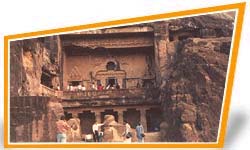
glimpsed the caves provides a magnificent sight of the U-Shaped gorge and its scenic surroundings. Ajanta has been designated as a World Heritage Site, to be preserved as an artistic legacy that will come to inspire and enrich the lives of generations to come.
- The Ellora CavesThe cave temples and monasteries at Ellora, excavated out of the vertical face of an escarpment are 26 kms north
of Aurangabad. Extending in a linear arrangement, the 34 caves contain Buddhist Chaityas, or halls of worship, and Viharas, or monasteries, Hindu and Jain temples. Spanning a period of about 600 years between the 5th and the 11th century A.D., the earliest excavation here is of the Dhumar Lena (cave 29). The most imposing excavation is, without doubt that of the magnificent Kailasa Temple (cave 16), which is the single largest monolithic structure in the World. Interestingly Ellora, unlike the sight of Ajanta was never rediscovered. Known as Verul in ancient times, it has continuously attracted pilgrims through the centuries. Ellora has been designated a World Heritage Site, to be preserved as an artistic legacy that will come to inspire and enrich the lives of generations to come.
- Bibi ka MaqbaraOne more tribute from a man to a woman, only this time, from a son to a mother. Modelled on the Taj Mahal, Aurangabad's Mughal tomb garden was built by Prince Azam Khan in memory of his mother, Begum Rabia Daurani.
- Daulatabad13 km away from Aurangabad lies one of the country's most impressive and majestic forts, commanding the view from atop a pyramid-shaped hilltop. It is an unusually large fortress and is surrounded by huge, imposing grey, granite walls and has a central, slender pink minaret called the Chandminar - a Victory tower built in 1435 and is right on top of the hill, originally known as Devagiri or the Hill of the Gods. There is also a 15 m deep moat encircling the upper portion of the citadel.
 Climate : -
 The summers sizzle with maximum temperatures hitting 40°C in May and winters are warm, with maximum temperatures falling to approximately 29°C. You could also visit Aurangabad between October and March, when the weather is pleasant.
Best times to visit Aurangabad : - Between the months of
June and September and from
October -
March.
How to Reach Aurangabad :
- By Road : Aurangabad is well connected to Mumbai (388 km), Nashik (221 km), Shirdi (136 km), Ajanta (110 km), Pune (299 km) and
Ellora (30 km).
- By Air : Indian Airlines and Jet Airways operate daily flights to Aurangabad from Mumbai and Delhi.
- By Rail : Super fast trains connect Aurangabad with Mumbai.